
A New Level of Control in Genome Editing
Prime editing represents one of the most sophisticated advancements in the evolution of genome engineering. Building on the foundations laid by CRISPR-Cas9 and base editing, prime editing introduces a method for rewriting DNA sequences with exceptional accuracy and minimal unintended changes. As highlighted in the presentation, this technology is designed to correct a wide range of genetic mutations without relying on double-strand breaks or donor DNA templates, making it a transformative tool for both research and therapeutic development.
How Prime Editing Rewrites DNA with Precision
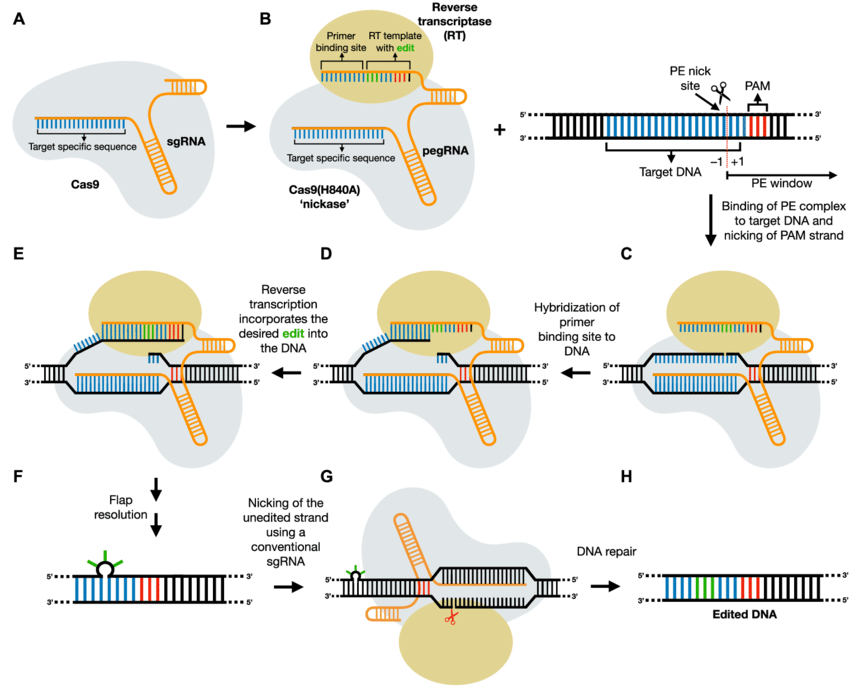
At the core of prime editing is a fusion protein that combines a Cas9 nickase with a reverse transcriptase enzyme. Instead of cutting both strands of DNA, the Cas9 nickase creates a single-strand break, which serves as an entry point for the reverse transcriptase to write a new DNA sequence directly into the genome. This process is guided by a prime editing guide RNA (pegRNA), which specifies both the target site and the desired edit. The result is a highly controlled and predictable modification that avoids many of the risks associated with traditional genome editing.
Expanding the Range of Possible Genetic Corrections
One of the most remarkable strengths of prime editing is its versatility. It can introduce insertions, deletions, and all twelve possible base-to-base conversions, covering the majority of known pathogenic mutations. Unlike homology-directed repair, which depends on the cell cycle and often yields low efficiency, prime editing operates across a broader range of cell types and conditions. The presentation emphasizes this flexibility, underscoring prime editing’s potential to address genetic diseases that were previously difficult or impossible to correct.
Transforming Therapeutic and Research Applications
Prime editing is already being explored for its therapeutic potential, with early studies demonstrating its ability to correct disease-causing mutations in cellular and animal models. Its precision and reduced reliance on double-strand breaks make it an attractive candidate for future clinical applications. In research settings, prime editing enables scientists to model diseases with unprecedented accuracy, facilitating deeper insights into gene function and molecular mechanisms. As the technology continues to mature, it is poised to become a cornerstone of next-generation genome engineering.
Image source: https://www.researchgate.net/figure/Schematic-representation-of-prime-editing-A-Prime-editors-PEs-consist-of-a-fusion_fig1_352051977
