

DNA profiling has become one of the most transformative tools in modern forensic science—not just because it solves crimes, but because it tells human stories. Every strand of DNA carries a signature, a quiet pattern of repeats and variations that makes each of us unmistakably unique. When scientists read those patterns, they’re not just analyzing molecules; they’re uncovering connections, restoring identities, and giving families long‑awaited answers.
The Language of Repeats: STRs and VNTRs
If DNA were a book, STRs and VNTRs would be the passages where the author got a little playful—repeating certain words or phrases again and again, but in different amounts from person to person.
- Short Tandem Repeats (STRs) are tiny sequences—just a few letters long—that repeat several times. One person might have the sequence GATA repeated 6 times at a particular location, while another might have it 10 times. These small differences become powerful markers because they vary so widely across the population.
- Variable Number Tandem Repeats (VNTRs) follow the same idea but on a larger scale. Their repeated sequences are longer, and the number of repeats can differ dramatically between individuals. VNTRs were the stars of early DNA profiling, though STRs eventually took center stage because they’re easier to analyze with modern techniques.
Together, these repeating patterns form a kind of biological barcode—one that no two people (except identical twins) share.
How a DNA Profile Comes to Life
The journey from a tiny biological trace to a readable DNA profile is almost cinematic. A single hair root, a drop of saliva, or a speck of blood is enough to begin.
 Extraction pulls the DNA out of the sample.
- PCR amplification makes millions of copies of the STR or VNTR regions—like zooming in on the most important pages of a book.
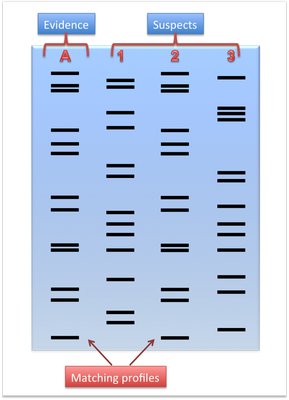
- Electrophoresis separates the DNA fragments by size, creating a ladder of bands.
- Comparison reveals whether two profiles align perfectly, suggesting they came from the same individual.
When two sets of bands line up, it’s a moment of clarity in an investigation.
Real‑World Stories: When DNA Gives People Back Their Names
Beyond the lab, DNA profiling has shaped some of the most emotional and impactful identification efforts of our time. These aren’t just scientific achievements—they’re human stories.
INTERPOL’s I-Familia: Reuniting Families Across Borders
Launched in 2021, I-Familia uses global kinship matching to identify missing persons when no direct DNA sample exists. A mother’s DNA in one country can help identify a child found in another. Families who spent decades in uncertainty have finally received answers.
Post-Conflict Identifications
In regions scarred by war—such as the Balkans, Rwanda, and parts of Latin America—mass graves left thousands unidentified. DNA profiling became a tool of healing. Entire communities saw long-lost relatives finally named, honored, and laid to rest.
Cold Cases and Indigenous Missing Persons
In North America, DNA profiling has helped reopen cases involving missing Indigenous women and girls. For families who had been unheard for years, DNA evidence brought long-awaited recognition and justice.
Disaster Victim Identification
After devastating events—tsunamis, earthquakes, plane crashes—DNA profiling has been the only reliable way to identify victims. In these moments, science becomes a bridge between tragedy and closure.
Each of these stories shows DNA profiling not as a cold forensic technique, but as a deeply human tool—one that restores identities and answers questions that once seemed unanswerable.
